THE SHARDS (2026) – Beautiful People, Dark Secrets and No Answers
Rating: ⭐⭐ 1/2
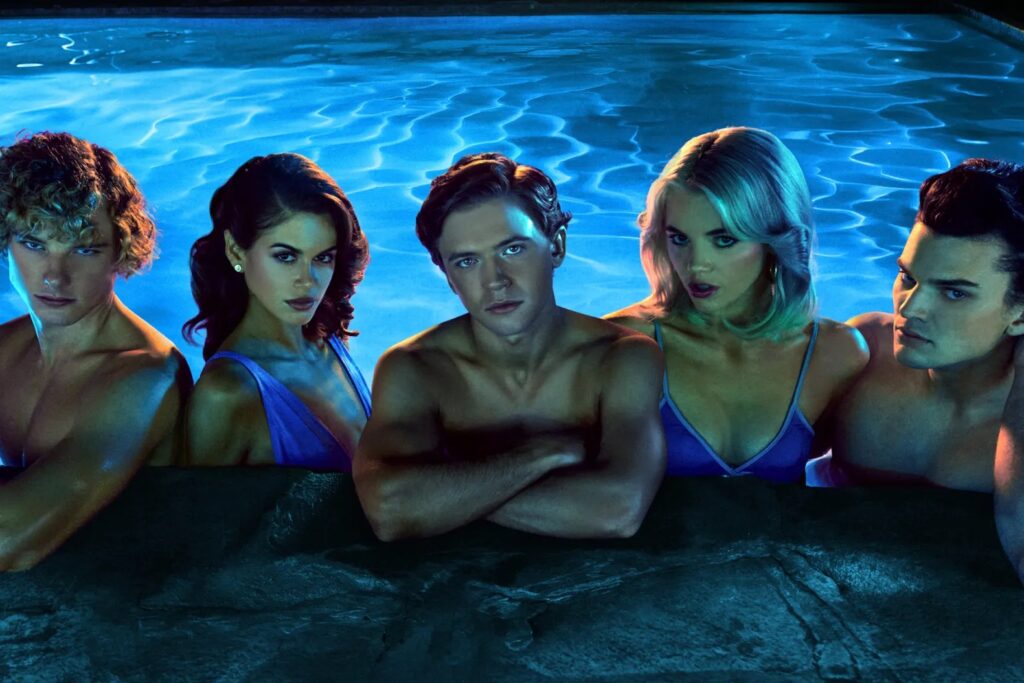
FX's The Shards -- Pictured: (l-r) Graham Campbell as Thom, Kaia Gerber as Susan, Igby Rigney as Bret, Hayes Warner as Debbie, Homer Gere as Robert. CR: Pari Dukovic/FX
Coming from producer Ryan Murphy, The Shards is hardly the sort of series one would expect to play it safe. Murphy has built a reputation for productions that are unorthodox, provocative and often scandalous, and this adaptation of Bret Easton Ellis’ novel is very much in that tradition.
Set in the 1980s, the series revolves around a group of wealthy, privileged white final-year high school students in Los Angeles. Their already self-indulgent world of parties, high school proms, drugs and sex is given a darker edge with the arrival of a mysterious and particularly brutal serial killer—or possibly killers—who appears to be targeting people around them. As disappearances mount and mutilated bodies are discovered, one might expect our protagonists to be consumed by fear. Instead, life largely goes on as usual. The murders seem almost like an unpleasant interruption to their privileged existence.
The exception is Bret, the series’ central character and narrator. Everything is largely filtered through his perspective, with his voice providing an almost constant stream of his thoughts and observations. An aspiring writer, Bret naturally looks at the people and events around him differently, treating his strange surroundings as potential material for the book he hopes to write. This makes him both an observer and participant in the increasingly disturbing events unfolding around him.
Like much of Ryan Murphy’s work, The Shards will not appeal to everyone. It pushes boundaries with its violence, sexual undertones and deliberately eccentric characters, while the plot constantly takes unexpected turns. There is a certain dreamlike quality to the storytelling where it becomes increasingly difficult to distinguish what is real, what is imagined and what we are actually supposed to believe. You may find yourself constantly trying to make sense of what is happening—and perhaps that is part of the point.
But The Shards is not entirely about the story. There is also a considerable amount of eye candy on display. The high school students look less like ordinary teenagers and more like a collection of supermodels who have wandered onto a film set. They walk, pose and carry themselves as though they are constantly being photographed for a fashion or glamour magazine. The camera clearly loves these young actors, frequently lingering on their impossibly flawless faces and carefully curated appearances.
Another major attraction is the soundtrack, which makes wonderful use of the music of the 1980s. The series is packed with familiar hits from the era, including plenty of memorable disco and dance tracks. The music not only enhances the period setting but also gives the series an infectious energy, particularly during its many party and nightlife scenes. Even when the story gets dark and disturbing, hearing these classic hits is a pleasure in itself and provides another reason to keep watching. For anyone nostalgic for the music of the 1980s, The Shards is almost as enjoyable to listen to as it is to watch.
It is this seductive audiovisual ppeal that helps draw you into the series. Even when the plot becomes increasingly strange and unpredictable, it is difficult to look away from all that glitter. Interestingly, the cast also includes celebrity offspring such as Kaia Gerber, daughter of supermodel Cindy Crawford, and Homer Gere, son of actor Richard Gere. Both have an undeniable screen presence and fit perfectly into the series’ rarefied world of beautiful, privileged teenagers.
I have to admit I enjoyed The Shards. I was sufficiently intrigued by its characters, atmosphere and increasingly bizarre mystery to look forward to each new episode. Unfortunately, all that goodwill came crashing down in the final act because the final episode is a complete let-down.
After spending the entire series building towards the revelation of the serial killer’s identity, the show delivers what ultimately feels like one gigantic tease. Just when we expect the mystery to finally be resolved, the series ends on a cliffhanger that reveals virtually nothing. There is no satisfying revelation, no real explanation and, most frustratingly, no closure whatsoever.
That is a particularly unforgivable way to end a series that has spent so much time asking its audience to invest in its mystery. If The Shards fails to attract enough viewers for a follow-up season, there is a very real possibility that we could be left permanently hanging, with all that build-up amounting to nothing.
The only alternative would be to turn to the source material—the novel The Shards by Bret Easton Ellis himself. The book adds another fascinating layer to the whole affair, as Ellis names the protagonist Bret, effectively turning the story into a strange, fictionalised version of his own youth. Perhaps that is fitting for a series as strange, provocative and self-conscious as The Shards. It certainly knows how to seduce its audience. It just doesn’t know how to say goodbye.