THE LAST HOUSE (2026) – Stranded in a House of Bad Writing
Rating: ⭐
Netflix has clearly worked hard to sell The Last House as its latest must-see slice of high-concept science fiction: ominous marketing, portentous imagery, and even a splashy Sunset Strip stunt reportedly involving a man living inside a billboard to drum up curiosity. To its credit, the campaign does what it is meant to do. It makes the film look intriguing, strange, and a must-see. Unfortunately, the film itself spends the next two hours proving that a clever advertising gimmick is no substitute for a bad movie.
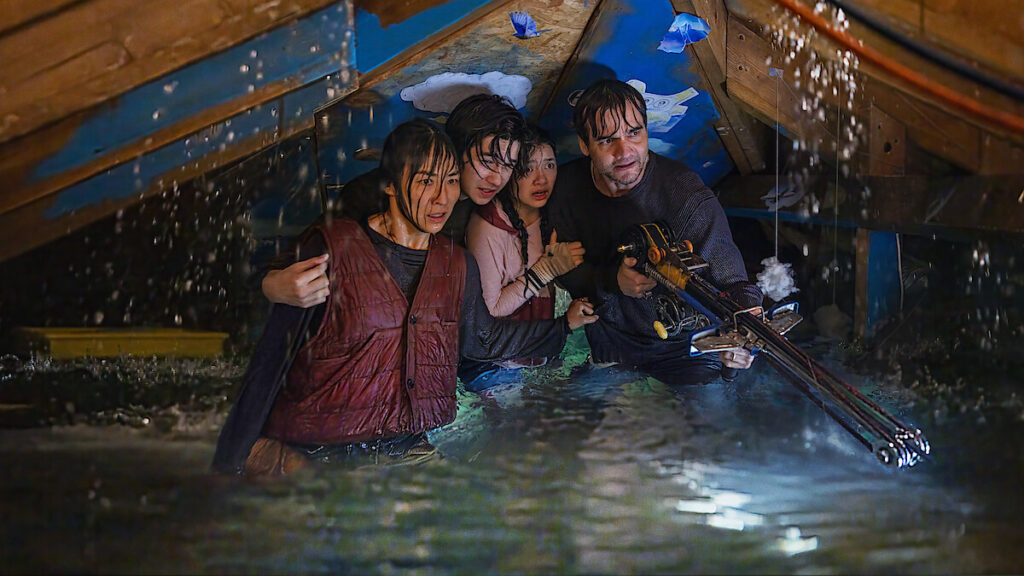
On paper, the set-up has genuine potential. A mysterious abnormality on Earth appears just as a storm approaches, leaving people inexplicably locked inside their homes. It is the kind of premise that should produce claustrophobia, paranoia, and escalating dread. For a brief moment, The Last House seems poised to explore how ordinary people might unravel when the world outside becomes inaccessible and unknowable. Instead, the film introduces us to a couple and their two young children, whose response to this terrifying situation is so bafflingly cheerful that suspense begins to collapse almost immediately. Rather than fear, confusion, or urgent survival planning, the family treats their imprisonment like an unusually long weekend retreat. They play games, bond, and float through the crisis with a breeziness that becomes harder to accept with every passing day, week, and month. By the time the obvious problem of dwindling food supplies finally penetrates their astonishingly calm household routine, it is difficult to feel much sympathy for people who appear to have mistaken the end of the world for a staycation.
The film’s problems extend well beyond its implausible plotting. The dialogue often sounds less like conversation than a parade of recycled genre clichés, delivered with a stiffness that suggests even the actors do not quite believe what they are saying. Greta Lee and Wagner Moura, both capable performers, are stranded here by material that asks them to behave with bewildering foolishness while speaking in lines that rarely feel spontaneous or human. Moura’s casting is especially disappointing given the acclaim he received for The Secret Agent; in his first prominent American project since that recognition, he seems oddly adrift, never convincing as either a resourceful father or a panicked survivor. Lee fares no better, giving what may be one of her least persuasive performances, while the lack of chemistry between the two leads further drains the central family dynamic of urgency or emotional weight. Even the children, rather than deepening the stakes, become part of the problem and by the way, they are pretty annoying too. At times, one cannot help wondering whether the story might have improved if the camera had simply wandered next door or further down the neighbourhood.
The final revelation does little to rescue the film from the absurdity that precedes it. Instead of recontextualising the story in a satisfying or unsettling way, it lands with the hollow thud of an explanation devised after the mystery had already run out of road. Science fiction can survive unlikely scenarios if they are anchored by emotional truth, intellectual curiosity, or visual imagination. The Last House offers too little of all three. What remains is a film that begins with a promising locked-room concept and ends as a frustrating exercise in wasted potential: not frightening enough to thrill, not smart enough to provoke, and not emotionally convincing enough to make its trapped family worth caring about. For all its apocalyptic packaging, the most chilling thing about The Last House is the realisation that the viewer has not merely been locked in with it for nearly two hours, but has had that time thoroughly wasted.