VLADIMIR (2026) – Rachel Weisz Leads a Witty, Wickedly Ambiguous Portrait of Desire and Disruption
Rating: ⭐⭐⭐
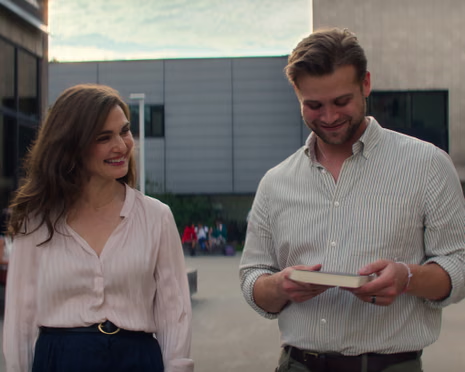
Rachel Weisz plays a middle-aged college professor and novelist whose carefully ordered life begins to unravel with almost theatrical precision. Her husband, a fellow academic at the same college, is accused of sexual misconduct involving his students; her daughter grows increasingly remote; her writing stalls; and, most dangerously, she finds herself drawn to a younger new lecturer, the Vladimir of the title. What might have been a familiar midlife-crisis drama instead becomes something sharper and more teasing: a portrait of a woman watching the certainties of marriage, motherhood, career and self-image collapse all at once.
The story unfolds entirely through Weisz’s character’s perspective, and the series makes that subjectivity explicit from its opening moments. She addresses the viewer directly, not merely narrating events but guiding us through the machinery of her own mind: her resentments, rationalisations, fantasies and fears. It is a far more intimate device than a conventional voice-over, drawing us into her predicament while also making us question the reliability of what we are being shown. Intriguingly, despite all this proximity, the series withholds her name. That omission feels deliberate, creating a sly ambiguity around whether we are watching her lived experience or some embellished, half-invented version of it emerging from her blocked imagination. Is this confession, fiction, or something seductively unstable in between?
Weisz, unsurprisingly, is excellent, giving the role intelligence, vanity, vulnerability and a dry comic edge without ever reducing the character to a type. The supporting cast is equally enjoyable. Leo Woodall, familiar to many from the second season of The White Lotus, brings just the right blend of charm and provocation to Vladimir, making it easy to understand both the attraction and the danger he represents. John Slattery and Ellen Robertson add texture as the husband and daughter, while the dialogue gives everyone room to spar. The verbal battering between characters is frequently funny because it is so precisely written, and the series is at its best when leaning into its witty, wicked strain of dark humour. Its world is populated by people who are flawed, articulate, self-aware and yet spectacularly capable of self-deception.
At eight episodes of roughly 30 minutes each, Vladimir is briskly paced and highly bingeable, but it is not lightweight. Beneath its elegant comic surface is a thorny study of ego, desire, authorship and the stories people tell themselves in order to survive disappointment. Clever, slippery and consistently watchable, it is the kind of series that invites both immediate enjoyment and post-viewing argument—which, for a story so invested in ambiguity, feels exactly right.