COLONY (2026) (Korean) – A Ferocious Return to Form: Colony Delivers Zombie Cinema with Bite, and Breathless Momentum
Rating: ⭐⭐⭐⭐
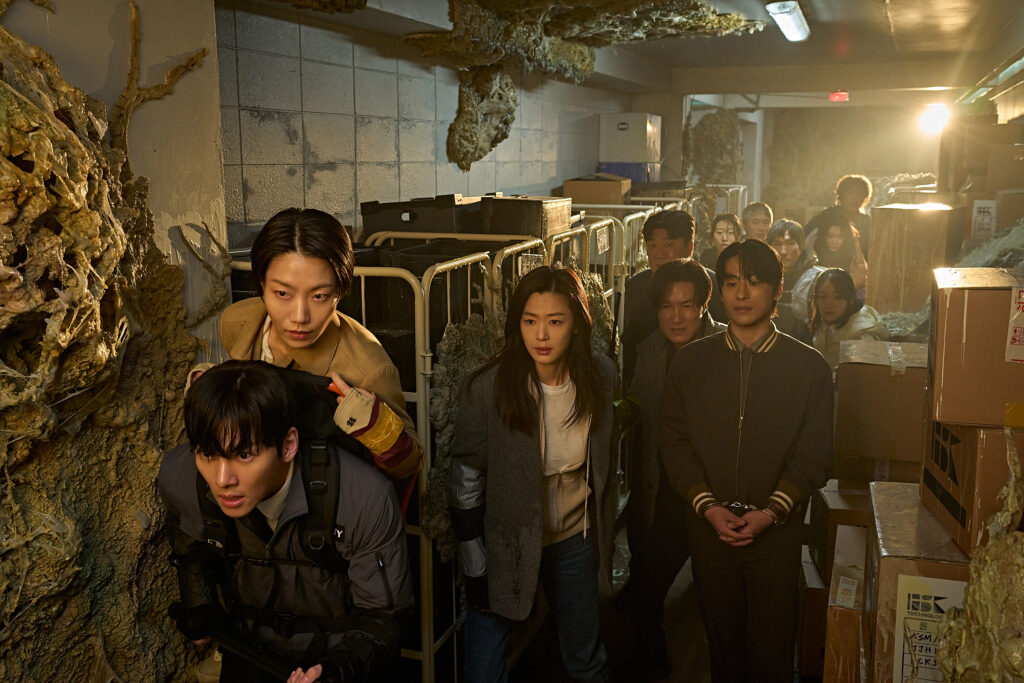
Colony marks Korean writer-director Yeon Sang-Ho’s long-awaited return to zombie filmmaking after Train to Busan (2016) and its follow-up, Peninsula (2020). Where Peninsula struggled to recapture the urgency and emotional precision of its predecessor, Colony arrives with a cleaner premise, a fresh cast, and a far sharper sense of purpose. Rather than trying to echo past triumphs, it carves out its own identity as a tense, self-contained survival thriller.
The film wastes little time dropping viewers into crisis. A mutating virus is unleashed inside a building when a vengeful scientist turns his creation into a weapon against a rival, setting off a lockdown nightmare that traps a group of survivors inside a quarantined complex. From there, Colony plays to one of the genre’s most reliable strengths: confinement. Yeon smartly introduces his key characters early, allowing the narrative to build emotional investment before the inevitable bloodletting begins. As alliances form, panic spreads, and escape routes collapse, the film earns its suspense not just through chaos, but through our growing attachment to the people trying to outlast it.
What makes Colony especially effective is its relentless forward drive. The action rarely loosens its grip, building toward a finale that feels both exhilarating and earned. Yet the film is more than a simple sprint from one set piece to the next. Its most clever touch lies in the virus itself: these are not static, one-note zombies, but creatures that mutate and evolve in alarming ways. That detail gives the film an extra layer of danger and unpredictability, refreshing a genre that has often been dulled by repetition. In a field crowded with familiar beats, Colony finds new ways to make old fears feel immediate.
To be sure, discerning viewers may balk at some of the characters’ decisions, particularly when the screenplay leans on panic-driven behaviour to push the story into darker territory. There are moments when logic gives way to momentum. But that trade-off feels easier to accept when the film is this gripping, this energetic, and this committed to delivering a full-throttle cinematic ride. The key is to meet Colony on its own terms: as a high-concept horror thriller driven by tension, escalation, and spectacle. Judged that way, it succeeds brilliantly. For me, Colony has all the right ingredients to stand as a genuine tour de force and Yeon Sang-Ho’s strongest zombie film since Train to Busan.