BLUE MOON (2025) – A Dialogue-Heavy Haunting Night of Genius and Regret
Rating: ⭐⭐⭐
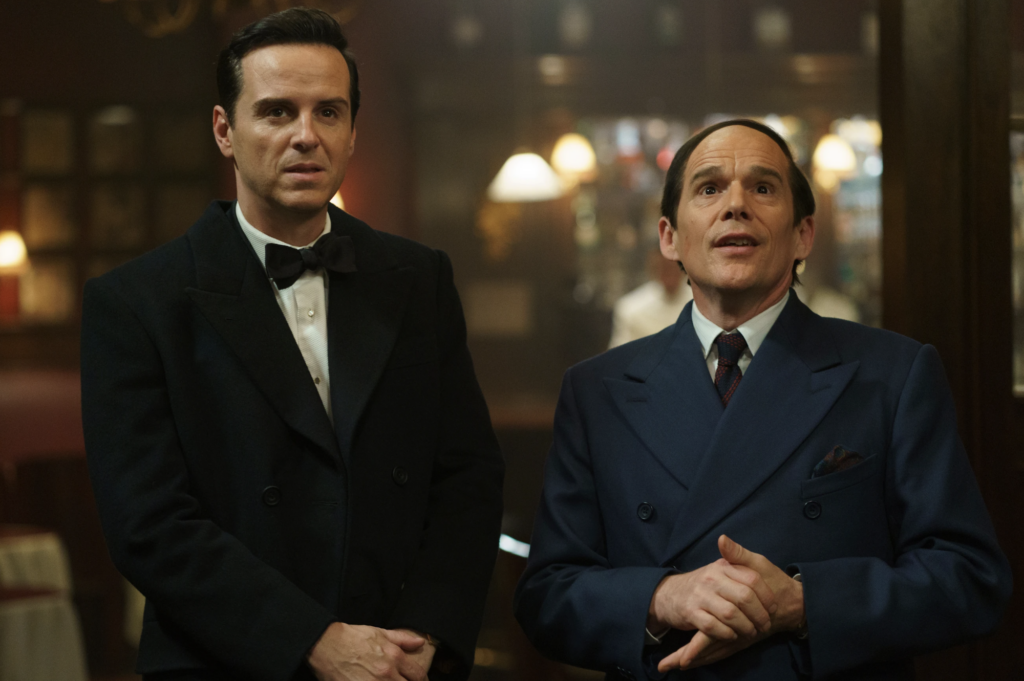
Director and writer Richard Linklater, renowned for his long-standing creative partnership with Ethan Hawke in the iconic “Before” Trilogy, reunites with his muse for a bold new venture in “Blue Moon.” This time, they trade sun-drenched wanderings for the moody, alcohol-laced shadows of a single pivotal night in the life of real-life lyricist Lorenz Hart—one half of the legendary songwriting duo Rodgers and Hart.
While Richard Rodgers soared to greater fame through his collaboration with Oscar Hammerstein—ushering in a golden age of musicals with classics like The Sound of Music, South Pacific, The King & I, and Oklahoma!—Hart spiralled into self-destructive obscurity from his alcohol addiction, haunted by personal demons and professional envy. “Blue Moon” zeroes in on what is perhaps Hart’s darkest hour: the opening night of Oklahoma! as he watches his former partner bask in critical acclaim, forcing Hart to confront the bitter fallout of their broken partnership.
Linklater masterfully contains the film’s action within a single location, unfolding nearly in real time as Hart, played with astonishing depth by Ethan Hawke, drowns his sorrows at a bar while waiting for the post-show festivities. Hawke’s performance is nothing short of revelatory—transformative and almost unrecognizable, he delivers a mesmerizing, near one-man show that mines the complex layers of Hart’s psyche through a relentless, emotionally charged monologue. Watching Hawke unravel Hart’s tangled regrets and longings is both intimate and devastating.
Supporting roles enrich the film’s nocturnal tapestry: Bobby Cannavale turns in a pitch-perfect performance as Eddie, the bartender whose quiet empathy anchors the night; Andrew Scott brings both charm and subtle tension as Richard Rodgers, deftly illustrating the irreparable rift between the two men. Most impressive of all was Margaret Qualley (remember her in The Substance?), luminous as Elizabeth, a fictional Yale student and Hart’s fleeting muse, injecting the proceedings with wit and vulnerability. Qualley’s Elizabeth, though invented, serves as a clever narrative device to reveal deeper facets of Hart’s inner life—her every appearance crackles with energy and intrigue.
“Blue Moon” is not a film for everyone. Its brilliance lies in its dialogue-heavy script and deliberate pacing, demanding patience and attention from the audience. For those willing to immerse themselves, however, it offers a rewarding glimpse into the tortured heart of a musical genius and the night that defined his legacy. Linklater’s willingness to embrace this unconventional storytelling approach marks “Blue Moon” as a daring and thought-provoking addition to his oeuvre—a welcome change of pace for fans of nuanced, character-driven cinema.
The title “Blue Moon” carries a rich, dual significance that resonates deeply throughout the film. On one level, it perfectly encapsulates the sombre, melancholic atmosphere that envelops Lorenz Hart during this crucial evening—the sense of longing, regret, and emotional isolation that defines his experience. Simultaneously, the title serves as a poignant nod to Rodgers and Hart’s most iconic composition, “Blue Moon,” a song celebrated for its haunting melody and lyrical depth.