BACKROOMS (2026) – Endless Corridors, Unanswered Questions
Rating: ⭐⭐
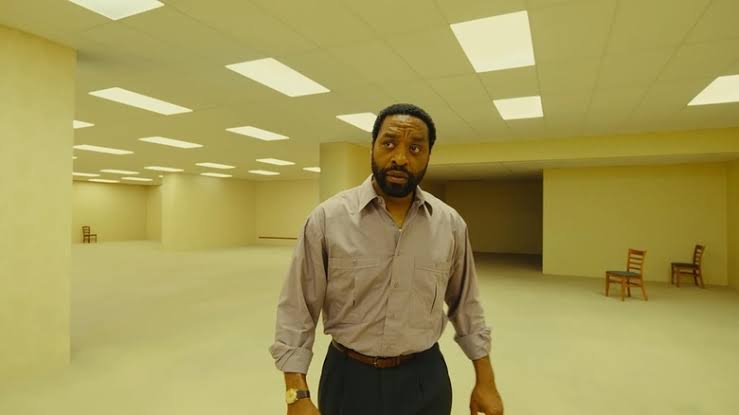
Backrooms arrives in cinemas carrying the kind of mythology most studio horror films would pay dearly to manufacture. Alongside the recent breakout hit Obsession, it has become part of a fascinating box-office story: small films, lean budgets, minimal traditional promotion, and enormous online curiosity. Obsession reportedly turned a tiny $750,000 budget into more than $286 million worldwide, while A24’s Backrooms managed to draw major attention on a comparatively modest $10 million spend.
Still, the success story around a film should never be mistaken for the film itself. As moviegoers, we eventually have to step past the headlines, ignore the victory lap, and meet the work on its own strange terms. That is where Backrooms becomes more complicated. I admired the originality of its premise and the way it turns the banal into something quietly menacing: a deserted furniture warehouse, a portal hidden in a basement wall, and beyond it an endless warren of half-empty yellow rooms and corridors. It is a superbly eerie idea, one that understands how fluorescent lighting, cheap carpet, and empty office-like spaces can feel more unsettling than any gothic mansion. Yet for all its atmosphere, I was never as gripped by Backrooms as I wanted to be. The film leans heavily on a handheld, point-of-view camera style that initially gives the experience an intimate, caught-on-tape anxiety, but over time becomes more exhausting than immersive. Used sparingly, the technique might have intensified key moments; used so liberally, it begins to feel less like a creative choice and more like a shield against the limitations of the production. The bigger issue, though, is narrative. The central mystery is undeniably compelling, but the intrigue gradually dissolves once it becomes clear that the film is not especially interested in offering shape, consequence, or coherence. By the final act, what should feel like revelation instead produces more confusion than enlightenment, as the film piles on ambiguity without giving the audience enough emotional or thematic payoff. In a world where anything can happen and almost nothing is explained, suspense risks turning into drift. Without clearer emotional stakes or a stronger sense that the characters matter beyond their function as frightened bodies moving through corridors, it becomes difficult to care deeply about their fate.
What Backrooms does prove, however, is that modern horror no longer needs a blockbuster budget to dominate the conversation. Kane Parsons shows real talent for mood, spatial unease, and claustrophobic tension, and the film contains flashes of terrific chase-driven momentum that suggest an even stronger version was possible. One wishes those bursts of danger arrived more often and that the film trusted story as much as it trusts atmosphere. Together with Obsession director Curry Barker, Parsons represents a new generation of online-born filmmakers who understand viral dread, digital folklore, and the peculiar fears of internet culture better than many industry veterans. If Backrooms is not a fully satisfying horror film, it is still an important signal flare: clever, unnerving, imperfect, and proof that the future of genre cinema may be hiding not in the biggest studio soundstage, but somewhere down a dim yellow corridor.