GODZILLA MINUS ZERO (2026) (Japanese) – More Roar, Less Heart
Rating: ⭐⭐⭐
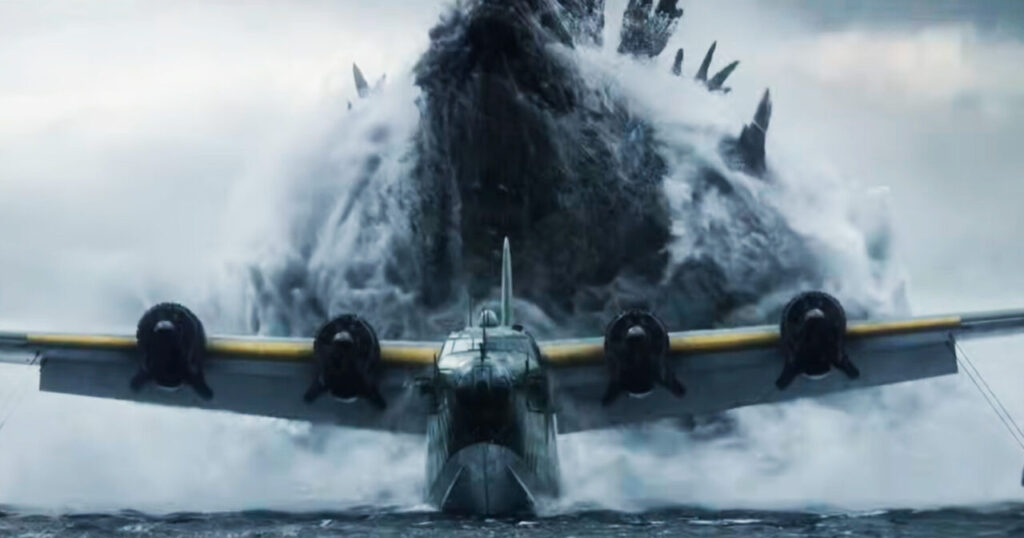
Godzilla Minus Zero is the eagerly awaited sequel to the Oscar-winning Godzilla Minus One, released barely three years ago. What made its predecessor such a remarkable phenomenon was not simply its monster spectacle or its place within a familiar movie franchise, but rather the extraordinary human story that elevated it to a level rarely achieved by films of this genre. Under the direction of Takashi Yamazaki, Godzilla Minus One was, at its heart, a deeply emotional human drama populated by characters we could identify with, empathise with and genuinely care about. The Godzilla element was seamlessly woven into this narrative, rather than being the sole attraction.
With Minus Zero, we once again reunite with the surviving characters from the first film. Just when life without Godzilla was beginning to feel almost comfortably normal for our heroes, Japan is confronted with another terrifying threat in the form of King Ghidorah, a monstrous, three-headed, dragon-like creature with devastating powers of destruction. Faced with a threat that conventional military weapons are seemingly incapable of overcoming, our protagonists once again put their thinking caps on to devise a strategy. Eventually, an extraordinary idea emerges: to enlist the recently resurrected Godzilla to confront and eliminate Ghidorah.
Running alongside the monster mayhem is another narrative that revisits some of the themes that gave the original film its emotional resonance. The horrors of war, the psychological scars of post-war depression, the importance of family and the enduring power of human camaraderie all feature prominently. These are familiar themes, but ones that Yamazaki clearly understands how to incorporate into a monster movie without losing sight of the human drama.
Visually, Minus Zero is an even more impressive spectacle. The CGI effects are astounding, while the thunderous sound design and deafening soundtrack make every monster appearance an overwhelming cinematic experience. The sheer scale and impact of the action sequences are particularly impressive when experienced on an IMAX screen. There is little doubt that the technical achievements here are a significant step forward.
However, when making the inevitable comparison with Minus One, I have to admit that the sequel’s overall delivery feels considerably less compelling. Despite its larger scale, more elaborate storyline and spectacular action sequences, something of the emotional magic that made the first film so special is missing.
The emotional anchor of Minus One was undoubtedly the relationship between Koichi, the traumatised kamikaze pilot, his wife Noriko and their adopted orphaned child, Akiko. Their struggles to rebuild their lives amidst the devastation of post-war Japan provided the film with a deeply affecting emotional core. Their personal journeys were so intimately connected to the larger monster narrative that the two elements became inseparable. In Minus Zero, however, this family dynamic does not carry quite the same emotional weight or devastating impact.
Instead, greater emphasis is placed on several new characters, particularly Professor Murakami, who harbours deep resentment towards the Americans over the nuclear bombing of Hiroshima, and Makoto, a brilliant meteorologist who has to contend with the gender prejudice of a male-dominated society. Both characters bring interesting dimensions to the story, and their respective struggles provide opportunities to explore some meaningful social and historical issues. Unfortunately, their individual journeys never quite achieve the emotional depth or resonance that the original film managed so effortlessly.
Perhaps this is the inevitable challenge of making a sequel to a film that succeeded precisely because it was so unexpectedly effective. Minus Zero is undoubtedly bigger, louder and technically more accomplished, but some of the novelty and emotional freshness of its predecessor have inevitably worn off. More spectacle does not necessarily translate into a more satisfying cinematic experience.
Nevertheless, Godzilla Minus Zero remains a remarkably accomplished monster movie and a testament to Takashi Yamazaki’s filmmaking abilities. It is also a timely reminder of what Hollywood often overlooks when producing its own giant-monster extravaganzas. Too frequently, the emphasis is placed almost entirely on action, destruction and visual effects, with the human characters relegated to little more than supporting roles. Yamazaki understands that even the most spectacular monster movie needs a compelling human story at its heart.
Minus Zero may not quite reach the extraordinary heights of Minus One, but it is still a hugely entertaining and visually magnificent cinematic experience. And that, in itself, is no small achievement.