THE DOG STARS (2026) – A Quiet Reminder of Why Ridley Scott Still Has It
Rating: ⭐⭐⭐
Despite the lukewarm reviews and a disastrous opening weekend at the box office, I decided to give The Dog Stars a chance. I have long learned not to let the critical consensus—or the box-office performance—dictate what I should or should not watch. More importantly, there was one name that was enough to get me into the cinema: Ridley Scott.
There seems to be a rather concerted effort these days to put down Scott’s recent work, something I find increasingly difficult to understand. While his latest films have certainly divided critics, I have found Napoleon, Gladiator II, House of Gucci and The Last Duel to be exceptional films—ambitious, visually magnificent and, in many respects, far superior to the majority of what Hollywood is producing today. I find it remarkable that, as he approaches 90, Scott can still command the screen with the visual confidence, scale and directorial precision of a filmmaker decades younger. His ability to continue producing ambitious films at this stage of his career is nothing short of extraordinary.
What is perhaps undeniable, however, is that The Dog Stars is a far smaller-scale project than many of Scott’s other films. That may throw some viewers off, particularly those expecting the spectacle and large-scale action sequences normally associated with his name. This is instead a slow-burn, intimate story—a tender exploration of human connections set against a post-apocalyptic backdrop, largely revolving around four main characters and a dog.
Under a lesser hand, this could easily have become an unbearably boring movie. But Ridley Scott is such a meticulous filmmaker that he makes sure virtually every frame is crafted with loving attention to detail. There is a remarkable beauty to the way he captures the mountains and forests, allowing us to experience their serenity while simultaneously contrasting them with the haunting remnants of the urban landscape left behind. We have seen these environments countless times in post-apocalyptic stories, but Scott’s vision somehow makes them feel more immediate, more atmospheric and, perhaps most importantly, more authentic.
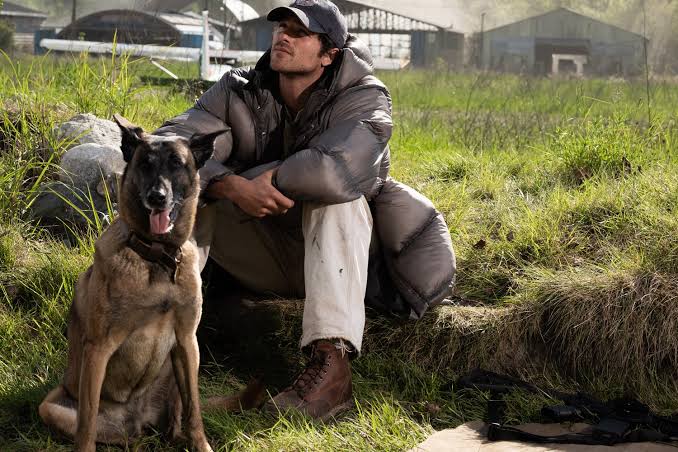
He has also assembled a terrific cast, headed by Jacob Elordi as Hig, a survivor who flies around in his small propeller airplane, searching for supplies while quietly hoping that there might still be a better life somewhere beyond his isolated existence.
Elordi has the physique and looks of a conventional Hollywood leading man, but what impresses me is his ability to take on roles that require him to be vulnerable, introspective and emotional. He does that particularly well here. I especially enjoyed the early scenes between Hig and his dog Jasper, where their relationship feels remarkably genuine. The dog is an important presence in the early part of the film, and apparently three identical-looking dogs were trained to perform different scenes. At least Jasper wasn’t created through CGI, which could easily have robbed those moments of the warmth and authenticity they possess.
Elordi is supported by strong performances from Josh Brolin, Guy Pearce and Margaret Qualley, the latter of whom I particularly enjoyed in The Substance. Together, the small ensemble gives the film a sense of intimacy that suits its deliberately restrained approach.
Ultimately, however, what left me somewhat disappointed was the way the story unfolds, particularly in its later half. We are suddenly introduced to the threat of ruthless groups of scavengers, followed by a misadventure involving a rather cultish community. These developments throw the otherwise idyllic existence of our protagonist off the rails.
While these encounters provide the film with some much-needed action, they also felt somewhat out of place to me—almost like isolated incidents grafted onto a story that had previously been content to explore the quieter, more contemplative side of survival. Perhaps this is simply a reflection of how the original story was written, and the need to remind us that beyond the tranquillity of a cabin in the wilderness lies a brutal new world order where humanity has reverted to its most basic instincts.
It is probably the one sore note in an otherwise beautifully realised film.
But even with those reservations, The Dog Stars is exceptionally well directed. Ridley Scott demonstrates once again that he doesn’t need enormous battles, elaborate sets or blockbuster spectacle to create something visually compelling. He understands how to use landscape, atmosphere, silence and the smallest details to immerse us in a world that feels both beautiful and deeply unsettling.
Perhaps this is why I continue to find myself defending Scott’s recent films when so many others seem determined to dismiss them. I still believe The Dog Stars is far better than a great deal of mainstream cinema being produced today. It may not be the Ridley Scott film that audiences were expecting, but there is something admirable about a filmmaker of his stature choosing to make something this quiet and intimate.
As for me, I will continue to look forward to every new Ridley Scott film. At this stage of his career, every new movie feels like another chapter in an extraordinary legacy—and one that I hope he continues adding to for as long as he possibly can.