THE HOUSEMAID (2025) – Formulaic Psychological Thriller with Star Power but Missing Substance
Rating: ⭐⭐
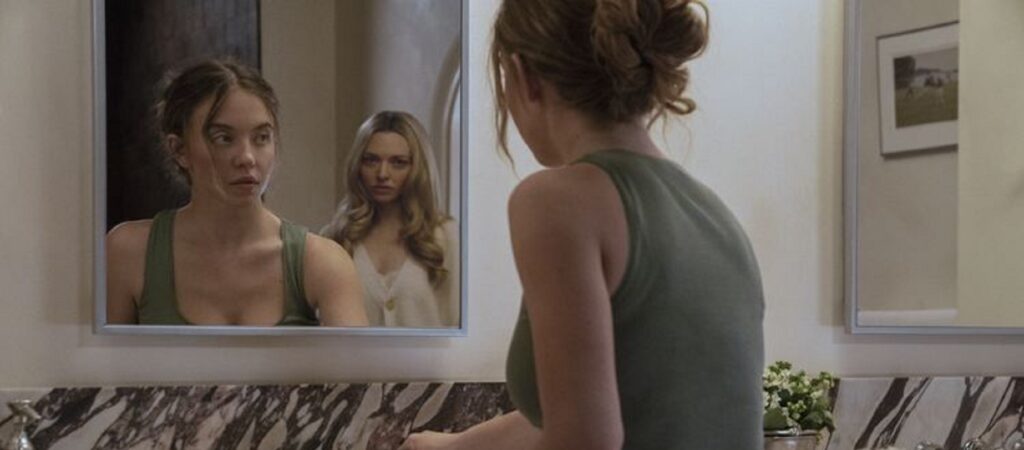
The Housemaid presents itself as a fresh entry into the psychological thriller genre, yet it quickly succumbs to a well-worn formula that undercuts its ambitions. The story follows Millie, a young woman whose stroke of luck appears when she is hired as a live-in housemaid for an affluent couple. What starts as a dream job rapidly unravels as Millie finds herself entangled in a web of suspicion, driven by the increasingly unhinged behavior of the lady of the house. Red flags abound, yet—for reasons that strain credulity—Millie chooses to stay, only to uncover secrets more dangerous than she could have imagined. Predictably, she is pulled so far into the household’s tangled mess that her own safety is thrown brutally into question.
Structurally, The Housemaid adheres closely to the conventions of its genre: characters frequently act in ways that are inconsistent and illogical, serving more to orchestrate red herrings than to build genuine suspense. Dialogue often feels forced and unnatural, detracting from the realism and making it difficult for viewers to invest in the characters’ plights. The film’s early intrigue—rooted in our curiosity about the truth behind the household’s dysfunction—unfortunately dissipates as the narrative progresses without delivering a coherent or satisfying payoff. Instead, scenes tend to meander, giving the sense that the runtime could have been halved without sacrificing any critical plot points.
If The Housemaid has a redeeming quality, it is found in its cast. Sydney Sweeney, a standout among her generation, typically brings nuance to her roles, but here she is underserved by a script that renders Millie as flat and implausible. Sweeney’s onscreen presence is undeniable, yet her character is reduced to a series of predictable choices and unnecessary exploitative moments that fail to advance the plot or develop her persona. Such scenes do little more than highlight her physical attributes, which feels gratuitous rather than meaningful.
Amanda Seyfried’s portrayal of the mentally unstable wife is similarly hampered by the screenplay. Known for bringing depth and relatability to her roles, Seyfried is here given little to work with, as her character’s motivations and emotional swings are too abrupt to be credible. The lack of subtlety in these characterizations ultimately undermines the film’s attempt at psychological complexity, leaving it feeling like little more than a shallow exercise in gender conflict.
It’s unfortunate that Hollywood no longer appears to produce smart psychological thrillers these days. Any Alfred Hitchcock’s films, by comparison, is significantly superior to many of today’s modern film makers’ foray into the genre.